

Spectrum is one of the satellite industry’s most valuable resources. But securing access to spectrum is only part of the challenge.
As demand grows for higher-capacity connectivity, resilient communications and more dynamic satellite services, operators also need to ask whether their ground infrastructure is ready to make effective use of that spectrum.
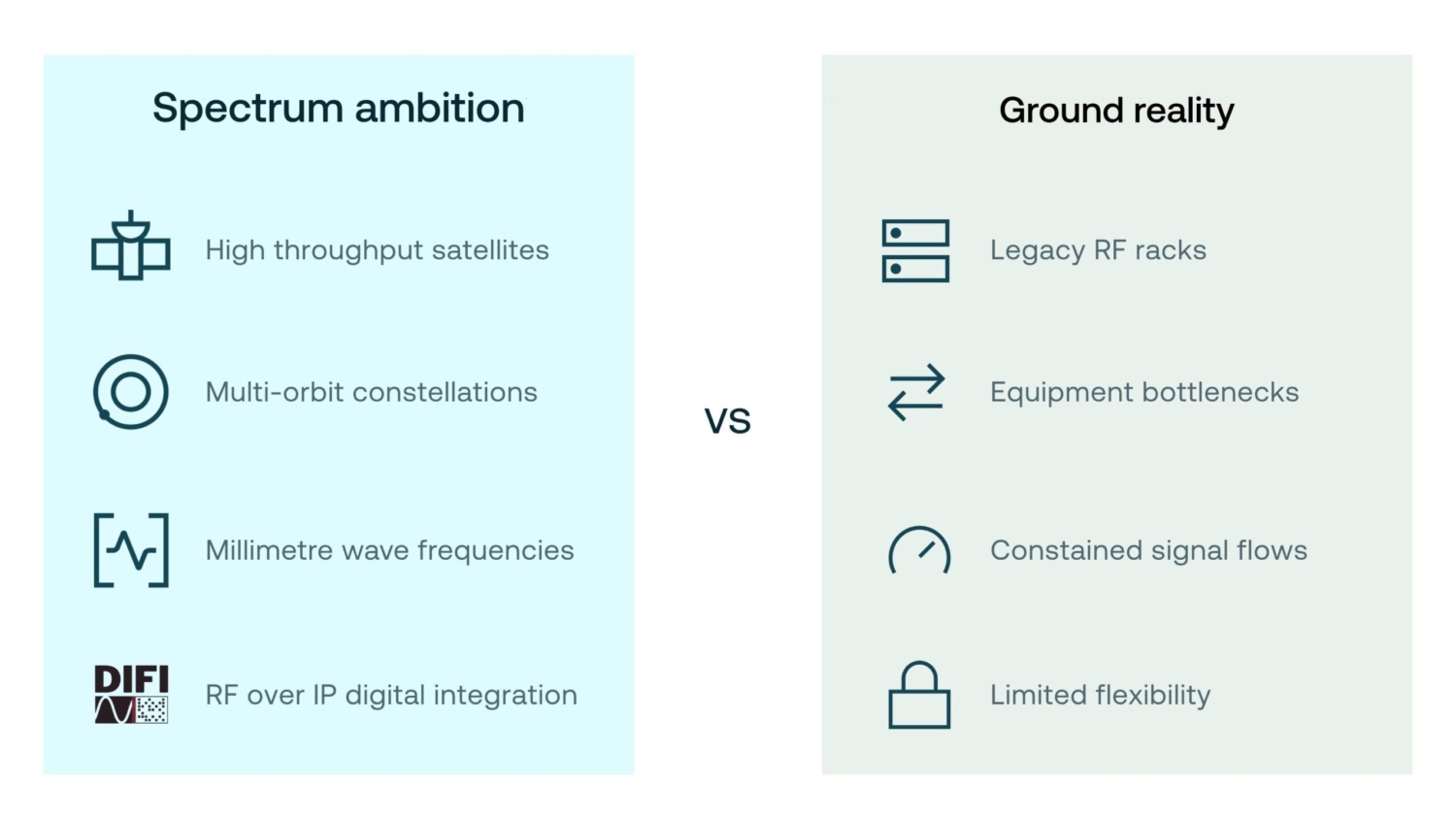
High-throughput satellites, expanding LEO constellations, earth observation missions, sovereign communications programmes and emerging multi-orbit services are all placing new demands on the ground segment. Networks must handle wider bandwidths, more complex RF environments and greater operational pressures, while remaining reliable, secure and adaptable.
This is creating a growing gap between spectrum ambition and ground segment reality.
An organisation may have access to the satellite capacity, services or frequency bands it needs. But its ability to exploit them fully will depend on the maturity of its architecture, operations and internal capability.
Spectrum readiness is therefore not simply a question of technology. It is a system-level challenge.

What does spectrum readiness mean?
Industry conversations about spectrum often focus on allocation, regulation and the transition towards higher-frequency bands.
These are important issues. However, even where spectrum is available, operators still need ground infrastructure capable of handling greater bandwidth, increased complexity and more demanding operating conditions.
At ETL Systems, we believe spectrum readiness should be assessed across three closely connected areas:
Architectural readiness: Can the ground segment support the bandwidth, flexibility, interoperability and scale required by current and future services?
Operational readiness: Can the system maintain performance, resilience and service continuity under real-world conditions?
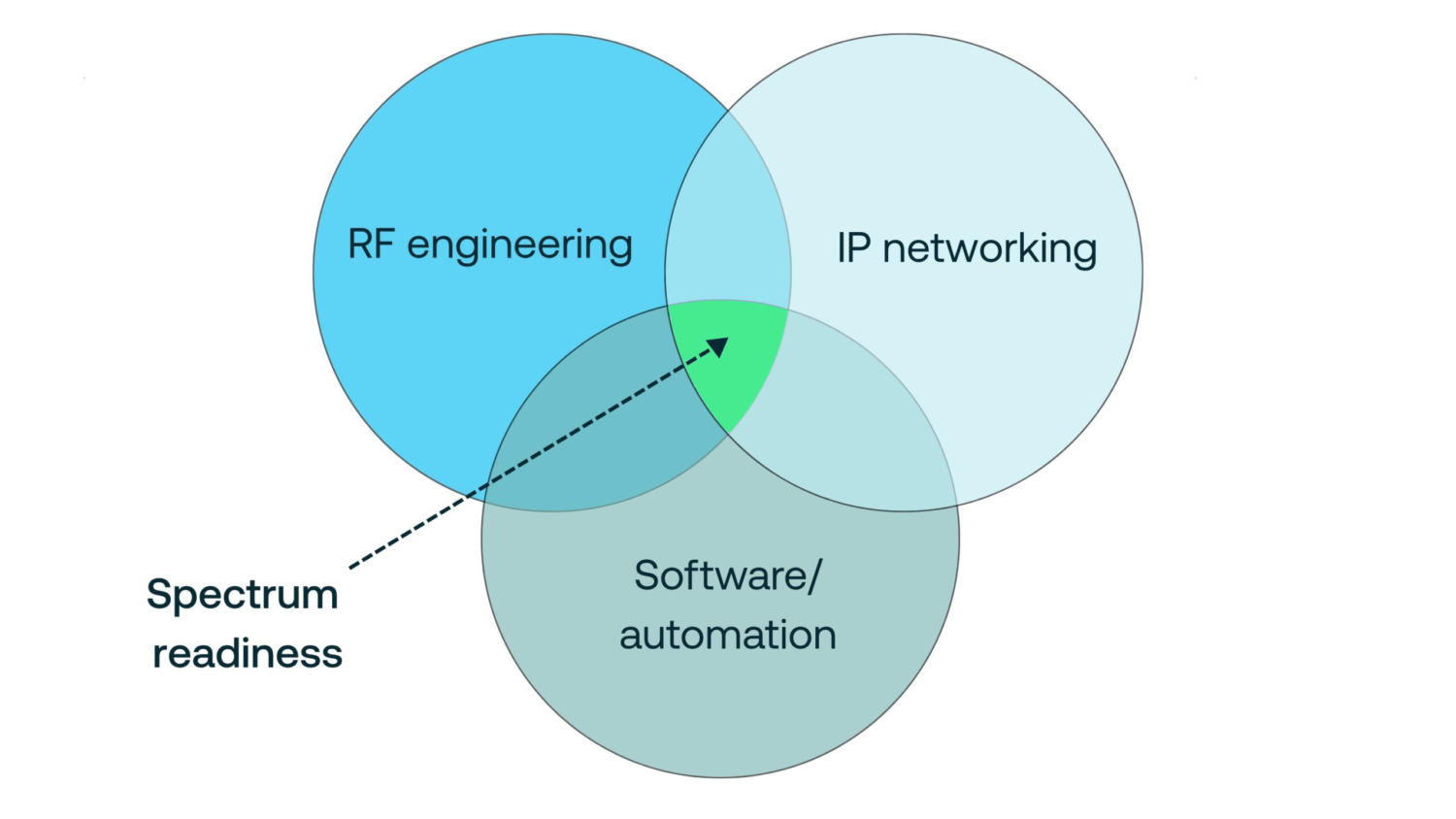
Organisational readiness: Do teams have the skills, ownership models and processes needed to manage increasingly digital and software-driven RF environments?
All three must develop together.
An advanced architecture can still underperform if operational teams cannot manage it effectively. A flexible system may fail to deliver its full value if an organisation lacks the required RF, networking or software expertise. Equally, access to additional spectrum achieves little if the ground segment becomes the bottleneck.
Moving beyond fixed ground infrastructure
Many operators are not starting with a blank sheet of paper.
Traditional analogue RF chains and L-band intermediate frequency architectures have supported the satellite industry reliably for decades. They continue to play a critical role in broadcast, defence, government and commercial satcom networks.
However, the requirements placed on those systems are changing.
Modern satellite environments increasingly need to support wider bandwidths, multiple frequency bands, dynamic routing, virtualised capabilities and interoperability across different vendors and network types.
Fixed or monolithic architectures can make that evolution difficult.
This is particularly relevant as the industry moves towards higher-frequency operation. Ka-band is already widely used in high-throughput satellite systems, while Q and V-band form part of the industry’s longer-term capacity roadmap.
These higher frequencies can unlock additional bandwidth, but they also place greater demands on gateways, RF distribution, signal transport and network resilience.
The central challenge for operators is therefore not deciding whether a future digital architecture is desirable. It is finding a practical way to evolve from the infrastructure they operate today.
Why hybrid architectures matter
For many organisations, a full replacement of existing ground infrastructure would be commercially difficult, operationally disruptive and unnecessarily risky.
Ground systems are capital-intensive, mission-critical and often embedded within established workflows. Removing infrastructure that continues to perform effectively may offer little immediate value.
This is why hybrid architectures are becoming increasingly important.
A hybrid architecture allows existing analogue infrastructure to continue delivering value while digitised capabilities are introduced where they provide the clearest operational or commercial benefit.
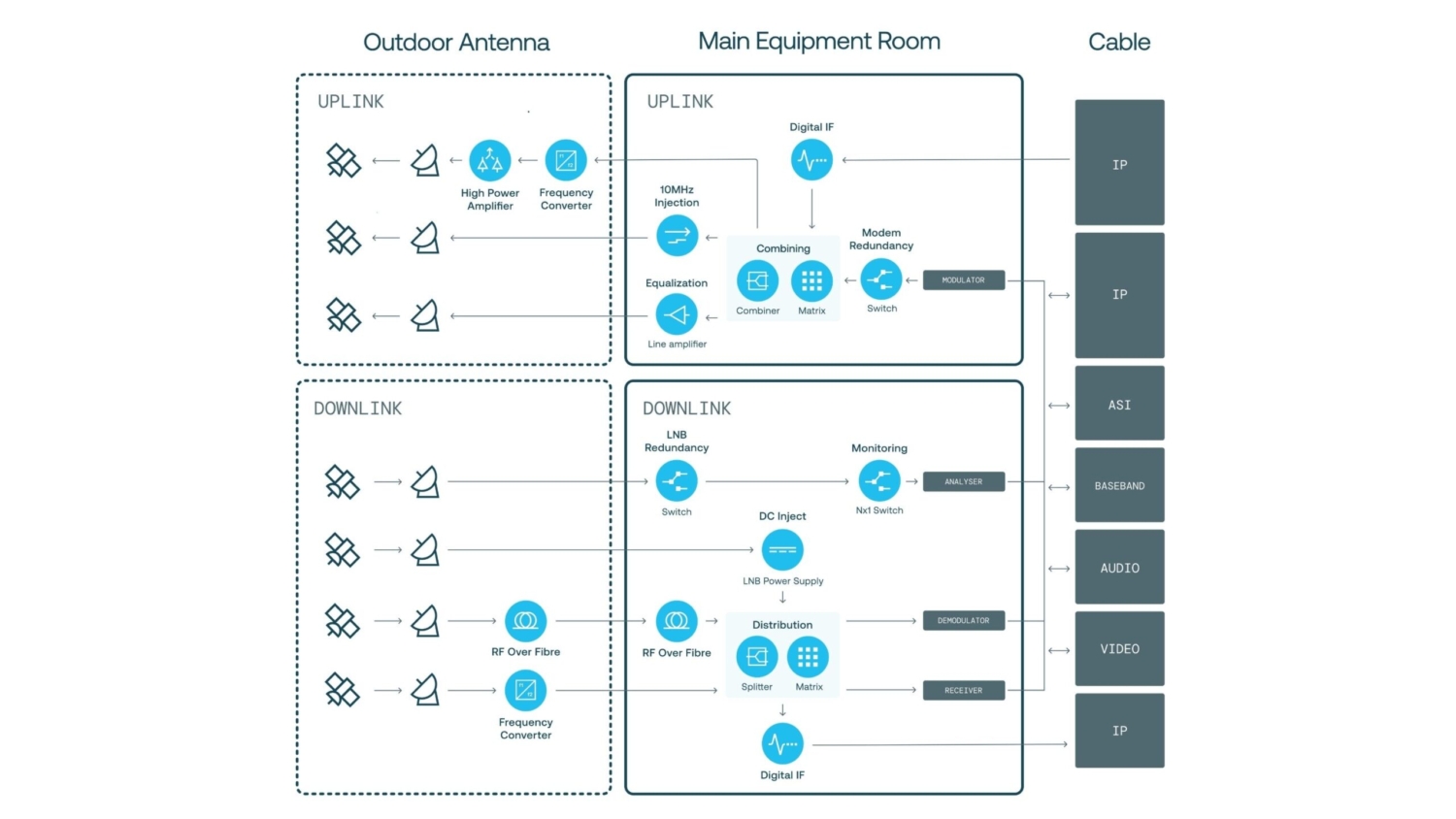
Operators may choose to digitise selected parts of the RF chain, introduce RF-over-IP transport between locations or add digital routing capabilities alongside existing analogue systems. This enables them to remove specific bottlenecks and increase flexibility without exposing the wider network to the risks of a full rip-and-replace programme.
The objective is not to digitise everything immediately. It is to create an architecture that can evolve incrementally and does not restrict future change.
Designing for real-world operations
Architecture determines what a system can do. Operations determine whether it can do it reliably.
Higher frequencies, wider bandwidths and more dynamic networks all introduce additional operational complexity. These challenges directly affect availability, service continuity and resilience.
Weather mitigation is one example.
As operators make greater use of higher-frequency bands, atmospheric effects such as rain fade become more significant. Maintaining availability may require site diversity, redundancy, adaptive routing and carefully designed failover strategies.
A spectrum-ready ground segment must therefore be engineered for real operating conditions rather than ideal assumptions.
Operators need to understand how traffic will be rerouted during disruption, how gateways will work together and how the wider system will respond when environmental or network conditions change.
The transport environment is equally important.
As digitised IF and RF-over-IP become more common, IP networks take on a greater role in signal transport. This introduces considerations including timing, latency, jitter, packet loss and network resilience.
These may appear to be conventional IT concerns, but within a digitised ground segment they can directly influence RF performance and service quality.
Successful deployment therefore requires closer collaboration between RF engineering, network, software and operational teams.
Preparing the organisation for digitised RF
The organisational implications of ground segment evolution can be just as significant as the technical ones.
Traditional RF expertise remains essential. However, as systems become more digitised and software-defined, it increasingly needs to be combined with knowledge of IP networking, automation, software platforms and cybersecurity.
This raises important questions about ownership.
Who is responsible for a digitised RF environment? Is it the RF engineering team, the IT department, network operations or a function that brings together all three?
Where responsibility is unclear, implementation can slow down, integration risks increase and organisations may struggle to realise the full value of new capabilities.
Training is therefore a critical part of readiness.
Digitised infrastructure can enable remote configuration, dynamic routing, scalability and more efficient use of resources. However, operational teams must be able to specify, monitor, maintain and troubleshoot the systems involved.
This is particularly important in defence, government, broadcast and essential connectivity environments, where operational confidence is as important as technical capability.
Ground segment modernisation should therefore be treated as a maturity journey rather than a standalone product decision. Technology is one part of the solution, but effective change also depends on skills, governance and clearly defined processes.
Building interoperability into the architecture
As ground systems become more complex, interoperability becomes increasingly important.
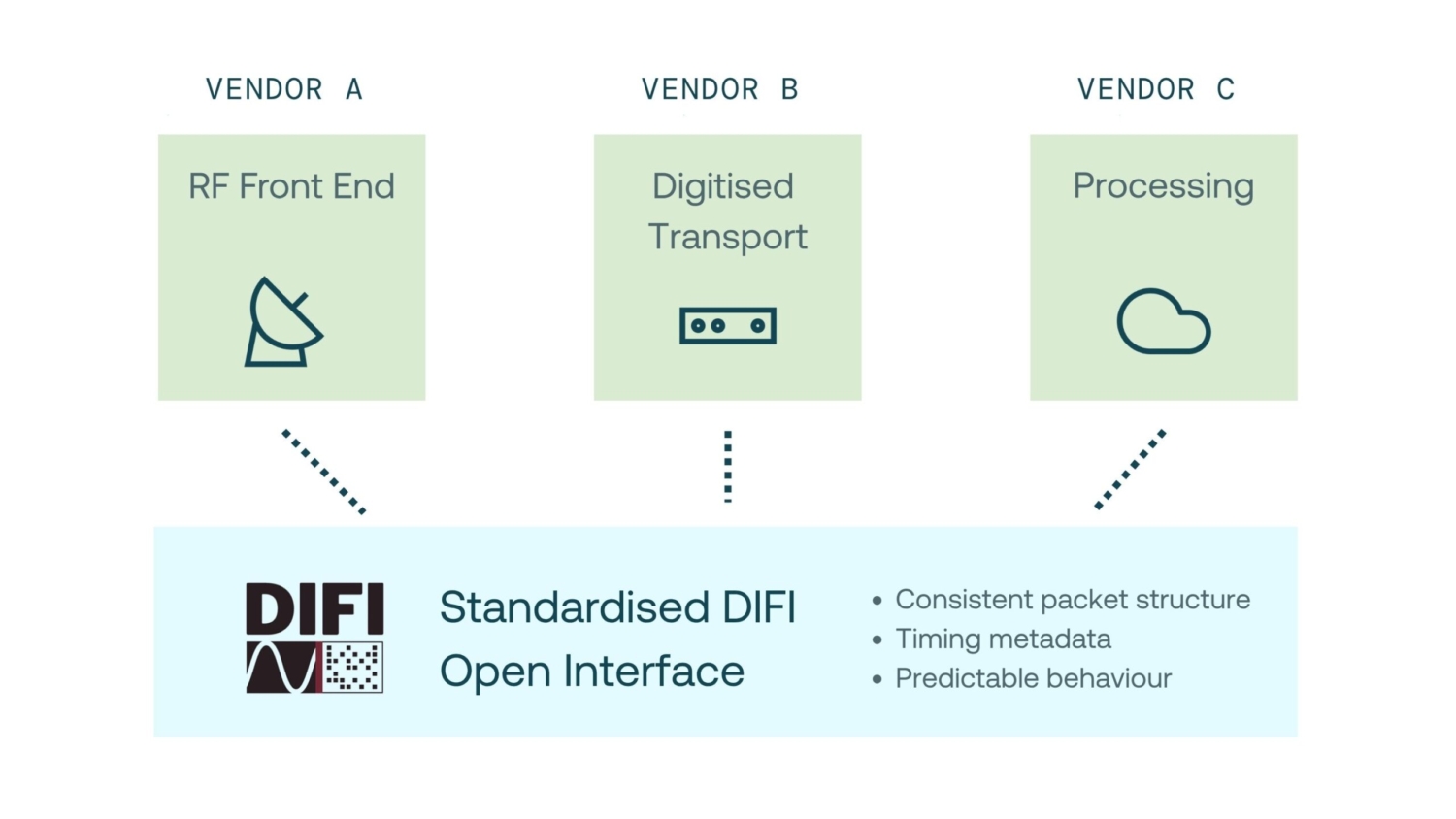
Operators need to connect technologies from different vendors and integrate new capabilities without creating unnecessary dependencies or limiting future choices.
Open standards can help.
Standards such as DIFI provide a common framework for transporting digitised IF signals and associated metadata between digital and RF domains. This can support interoperability across multi-vendor environments and make it easier for operators to build more flexible architectures.
However, adopting a standard does not automatically create an interoperable or spectrum-ready system.
The standard must be correctly specified, implemented and integrated into an architecture designed around the operator’s wider technical and operational requirements.
Interoperability should therefore be treated as a design principle rather than a product feature.
The decisions operators make today will influence how easily they can add future services, support new frequency bands, integrate additional partners and respond to changing mission requirements.
Avoiding architectural lock-in
Vendor lock-in is often viewed primarily as a procurement or commercial concern. It can also become a significant technical constraint.
Systems built around proprietary interfaces or highly rigid architectures can be difficult to adapt. Operators may find it harder to introduce new technologies, integrate emerging standards or respond to changes in spectrum and service requirements.
This is particularly relevant in sovereign and defence networks, where control, resilience and long-term adaptability are central considerations. However, it also matters to commercial operators working in fast-changing markets.
A spectrum-ready architecture should therefore use modular components and open interfaces where appropriate, supported by a clearly defined migration strategy.
The aim is not to eliminate all proprietary technology. It is to avoid making individual technology decisions that unnecessarily restrict the future development of the wider system.
What does a spectrum-ready ground segment look like?
There is no single end-state that will be appropriate for every operator.
A less mature environment may be characterised by fixed RF chains, limited scalability, siloed teams and little flexibility to accommodate new bands, sites or service models.
The system may continue to perform effectively for current requirements, but become increasingly difficult or expensive to evolve as demand grows.
A more mature environment is likely to combine analogue and digital capabilities within a deliberate hybrid architecture.
It will be modular enough to support future change, resilient enough to maintain performance under real operating conditions and interoperable enough to avoid unnecessary constraints.
Operationally, it will incorporate appropriate redundancy, site diversity, weather mitigation and resilient signal transport.
Organisationally, it will bring RF, IT, networking and software expertise together rather than treating them as separate disciplines.
Spectrum readiness is not about reaching a perfect technical end-state. It is about establishing a controlled, scalable and adaptable pathway from today’s infrastructure to tomorrow’s requirements.
Creating a practical migration path
The next era of satellite communications will continue to increase the demands placed on ground infrastructure.
Higher-frequency operation, growing data volumes, multi-orbit services, sovereign communications requirements and the need for greater broadcast and network resilience will all require more adaptable ground systems.
However, readiness will not be achieved through a series of isolated equipment upgrades.
Operators need to consider how architecture, operations and organisational capability will evolve together.
A practical starting point is to assess where existing infrastructure may constrain future services. That means asking:
- Where are the bottlenecks within the RF chain?
- Can the architecture support wider bandwidths and additional services?
- How easily can new sites, vendors or technologies be integrated?
- Are operational processes designed for greater network complexity?
- Do teams have the skills and ownership structures required to manage digitised RF systems?
- Where would digitisation create the greatest immediate benefit?
The answers will help operators identify which capabilities should be prioritised and where a staged migration approach can reduce risk.
At ETL Systems, we work with satellite operators, governments, defence organisations, broadcasters and service providers to help them evolve ground infrastructure without compromising existing operations.
By combining modular RF distribution, resilient architectures and practical migration pathways, organisations can protect the value of their current infrastructure while preparing for future spectrum, bandwidth and interoperability requirements.
Spectrum ambition is accelerating. The organisations best placed to benefit will be those that treat the ground segment not as supporting infrastructure, but as a strategic capability in its own right.