
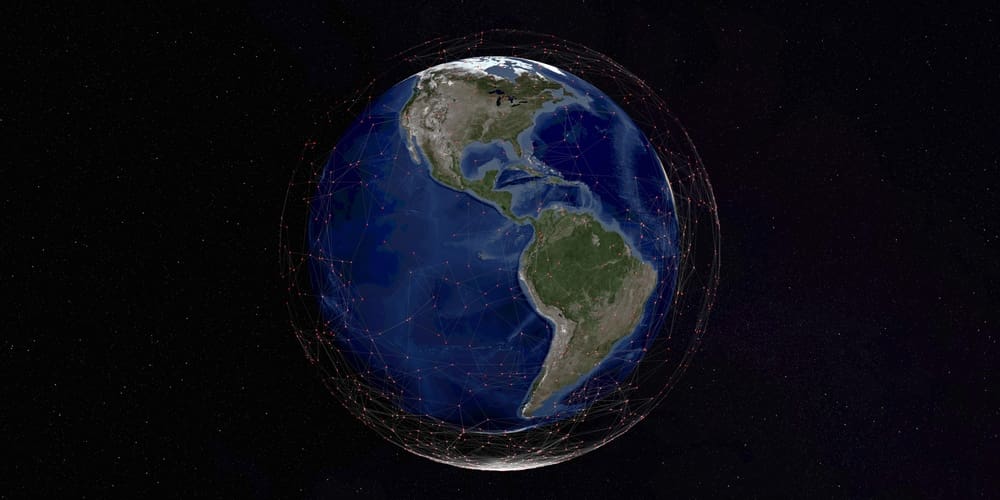
Satellite communication networks are under growing pressure. In the face of soaring demand across both commercial and governmental sectors and at a time when a multiplicity of influencing factors are converging – changing geopolitical dynamics, multi-X operation, sovereign satcoms requirements, 5G/NTN integration – organisations are reevaluating how their ground segment is designed and operated.
One of the lynchpins of this evolution is the movement away from analogue RF architectures towards IP-native, virtualised systems – and this requires Digital IF technology.
As planners look to 2026 and beyond, Digital IF has established itself as a critical technology underpinning virtualisation, agility, and the security of future RF distribution. For defence operators, embracing the evolution is no longer a question of innovation but one of operational readiness.
Simon Swift, chair of difi specification working group & Engineering director, etl systems
This shift is no longer purely theoretical. It has become a strategic priority for defence and government operators planning for the second half of this decade.
Drawing on insights shared by Simon Swift, our Engineering Director for Digital Technologies and Chair of the DIFI Specification Working Group, we explore three urgent drivers behind this transition.
Enabling virtualisation
The virtualised ground segment reshapes almost every aspect of modern network design. Software-defined, cloud-ready architectures reduce reliance on resource-intensive hardware, and enable the satellite ground segment to respond in almost real-time to changing mission parameters through rapid reconfiguration.
Digital IF, sometimes known as RF over IP, is a cornerstone of the virtualised ground station. By converting RF signals into IP streams close to the point of reception/transmission, operators are able to decouple signal processing from physical hardware such as antennas. This reduces risk exposure for on-the-ground assets.
It also means that functions traditionally tied to racks of hardware, like modems, spectrum analysers, or signal monitoring, can instead be implemented as virtualised platforms running on COTS compute devices.
The change delivers tangible benefits. Faster deployments of new capabilities and the ability to scale processing resources dynamically in response to emerging threat or operational demand will unlock an agility that traditional satcoms struggles to offer – it is one of the factors that makes Digital IF critical to the defence and government sectors.
Operational agility and resilience
Most legacy ground station architectures were designed around a fixed site and predictable operating conditions. It’s one of the reasons the unprecedented scale of demand – which is far outstripping even the most generous estimates from a decade or more ago – is requiring radical innovation in ground-based technologies. Today’s networks are often operating in a very different reality than their original design accommodated.
The need for distributed operations, sometimes in contested environments, and the flexibility to scale demand a ground segment that is both resilient and adaptable. Digital IF supports this by enabling RF transportation over IP networks. Not only does this eliminate signal degradation regardless of distance, but once the signal is in the digital domain, it can be routed, duplicated, encrypted, and processed wherever capacity is available.
This flexibility enhances network resilience. It enables site diversity and load balancing without complex RF switching. It supports automated or rapid-response failover between sites or feeds. And, when combined with virtualised signal processing, it means that critical capabilities can be restored or repaired quickly in response to disruption – that is a key consideration for mission-critical applications.
Flexible distribution of RF
Modern defence networks rarely operate in isolation. As government and commercial entities integrate more and more, networks must maintain cohesion across multiple partners and platforms while maintaining operational security. Traditional RF models are not best suited to support this level of flexibility.
Digital IF changes the equation. By treating RF as data, operators can manage and secure feeds using established IP networking principles. This enables:
- Seamless distribution of RF across geographically distant sites without signal loss
- Secure, ‘behind the wire’ encryption aligned with sovereign protocols
- The dynamism to support multi-X operations through multi-orbit, multi-constellation, waveform-agnostic technologies
Equally critical here is interoperability. The emergence of open standards such as DIFI is helping to prevent vendor lock-in, ensuring that equipment from different suppliers will work together within a common IP-based framework. For defence and government users, this feeds a more competitive, more resilient supply chain that is integral to maintaining continuity of operations and compliant procurement.
From strategy to implementation
The shift from legacy RF to IP is not going to be an overnight process. Most organisations will adopt Digital IF incrementally, integrating it alongside existing RF infrastructure as part of a broader modernisation programme.
What is clear is that digitisation is now moving beyond large gateways and centralised control rooms. Digital IF capability is extending towards the network edge as digitisers designed to mount directly to the antenna come online. Defence and government operators are looking ahead to rapid-response deployments and truly mobile satcoms operations, untethered to hardware constraints.
As planners look to 2026 and beyond, Digital IF has established itself as a critical technology underpinning virtualisation, agility, and the security of future RF distribution. For defence operators, embracing the evolution is no longer a question of innovation but one of operational readiness.
Interested in learning more about how Digital IF and digitisation at the edge are reshaping satcoms? Follow our ‘digitisation at the edge’ series for further insights or get in touch with our team for more information.